CRAM COURSES
Don't know where to start?
Don't know where to stop?
Allow us to help you run through all the topics you need to ace your entrance tests!
MATHEMATICS
From Divisibility rules to Derivatives & Differentiation, we are here to help you master the basics and build your confidence in complex problems. The lecturer ALWAYS received excellent ratings from previous students.Click MORE to see the outline and the lecturer for the Cram Course.

CHEMISTRY
From Foundations of Matter to Organic Chemistry, allow yourself to learn from a Chemistry enthusiast, UPCAT passer, DOST scholar, and magna cum laude!Click MORE to see the outline and the lecturer for the Cram Course.
PHYSICS
From the easy topics of Measurement to overwhelming types of motion & forces, allow yourself to learn physics from an engineering student and UPCAT passer!Click MORE to see the outline and the lecturer for the Cram Course.

Cram Course 1
Back to Basics: Mathematics
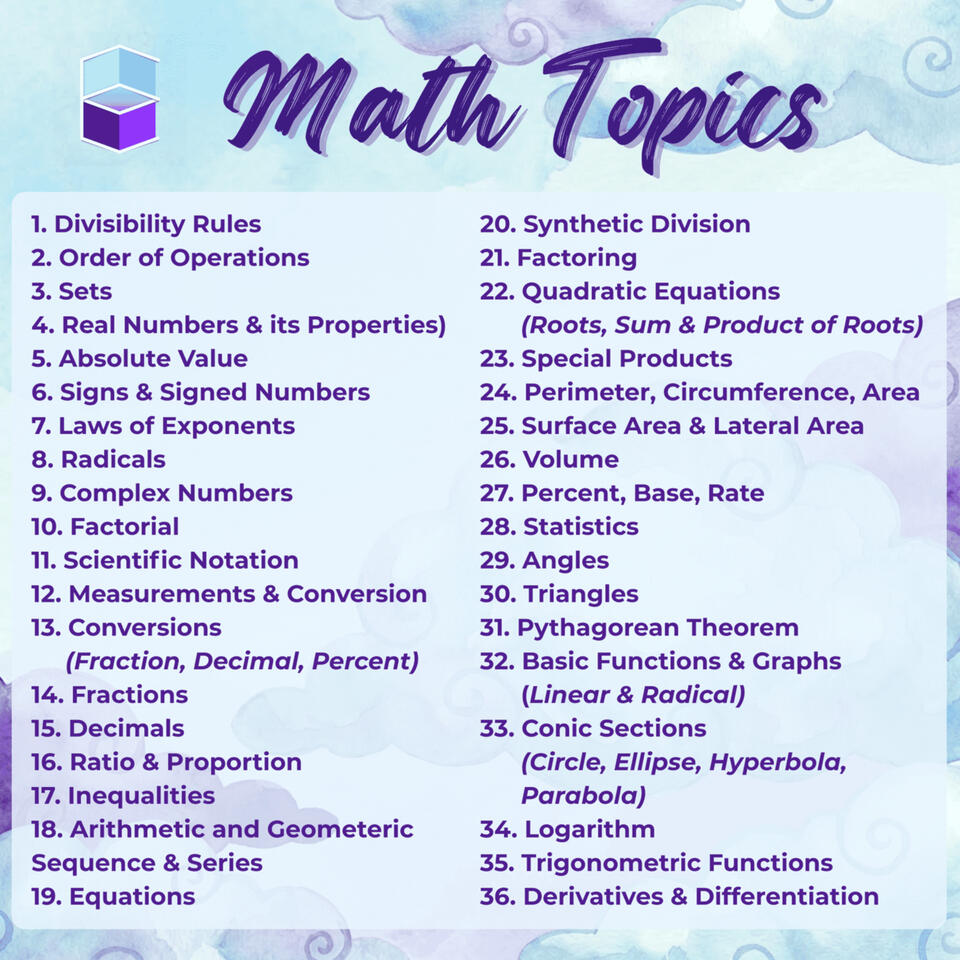
OUTLINE OF TOPICS
1. Divisibility Rules
2. Order of Operations
3. Sets
4. Real Numbers (& its Properties)
5. Absolute Value
6. Signs & Signed Numbers
7. Laws of Exponents
8. Radicals
9. Complex Numbers
10. Factorial
11. Scientific Notation
12. Measurements & Conversion
13. Conversions (Fraction, Decimal, Percent)
14. Fractions
15. Decimals
16. Ratio & Proportion
17. Inequalities
18. Arithmetic and Geomteric Sequence & Series
19. Equations
20. Synthetic Division
21. Factoring
22. Quadratic Equations (Roots, Sum & Product of Roots)
23. Special Products
24. Perimeter, Circumference, Area
25. Surface Area & Lateral Area
26. Volume
27. Percent, Base, Rate
28. Statistics
29. Angles
30. Triangles
31. Pythagorean Theorem
32. Basic Functions & Graphs (Linear & Radical)
33. Conic Sections (Circle, Ellipse, Hyperbola, Parabola)
34. Logarithm
35. Trigonometric Functions
36. Derivatives & Differentiation

Cram Course 1
Back to Basics: Chemistry
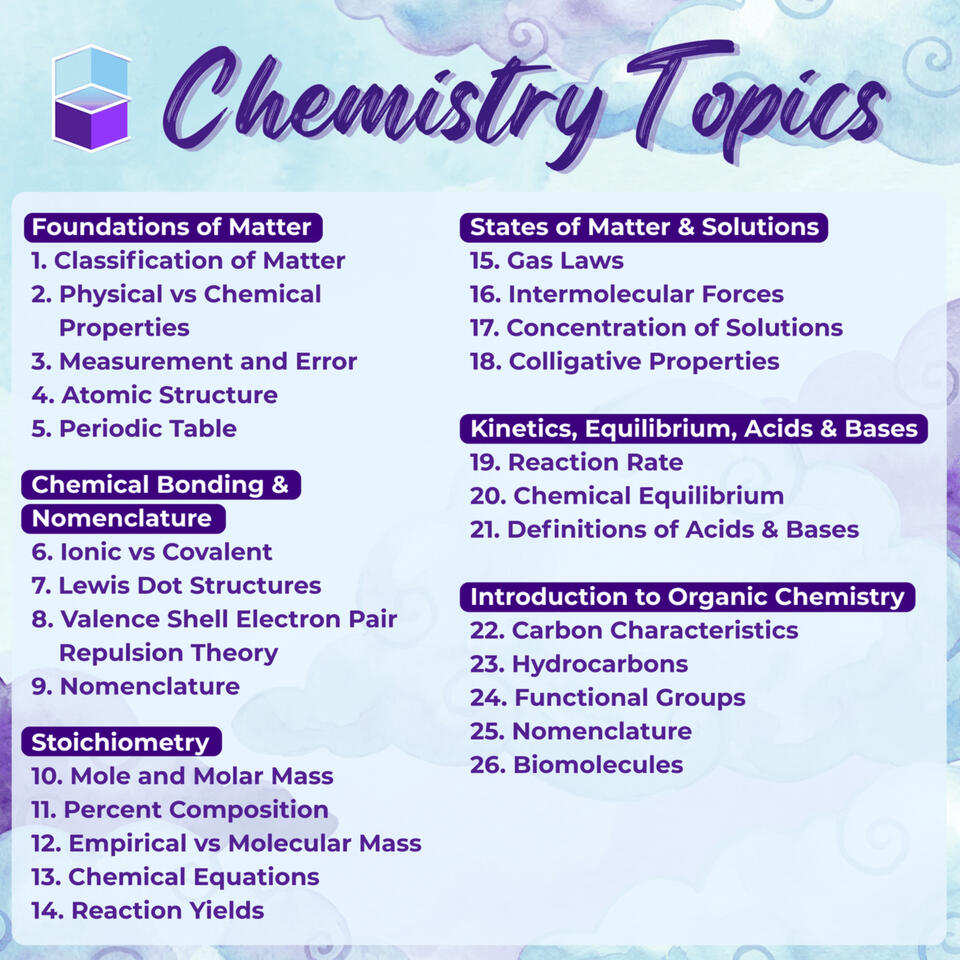
OUTLINE OF TOPICS
Foundations of Matter
1. Classification of Matter
2. Physical vs Chemical Properties
3. Measurement and Error
4. Atomic Structure
5. Periodic Table
Chemical Bonding & Nomenclature
6. Ionic vs Covalent
7. Lewis Dot Structures
8. Valence Shell Electron Pair Repulsion Theory
9. Nomenclature
Stoichiometry
10. Mole and Molar Mass
11. Percent Composition
12. Empirical vs Molecular Mass
13. Chemical Equations
14. Reaction Yields
States of Matter & Solutions
15. Gas Laws
16. Intermolecular Forces
17. Concentration of Solutions
18. Colligative Properties
Kinetics, Equilibrium, Acids & Bases
19. Reaction Rates
20. Chemical Equilibrium
21. Definitions of Acids & Bases
Introduction to Organic Chemistry
22. Carbon Characteristics
23. Hydrocarbons
24. Functional Groups
25. Nomenclature
26. Biomolecules

Cram Course 1
Back to Basics: Physics
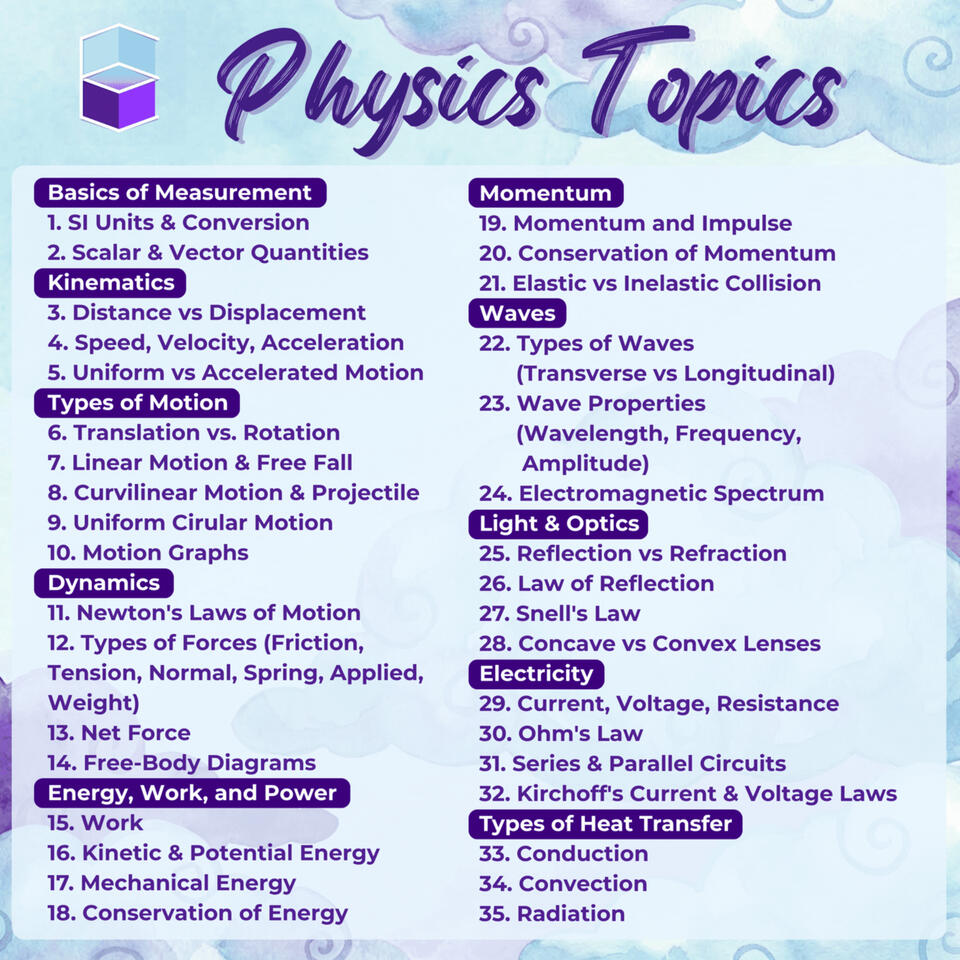
OUTLINE OF TOPICS
Basics of Measurement
1. SI Units & Conversion
2. Scalar & Vector Quantities
Kinematics
3. Distance vs Displacement
4. Speed, Velocity, Acceleration
5. Uniform vs Accelerated Motion
Types of Motion
6. Translation vs. Rotation
7. Linear Motion & Free Fall
8. Curvilinear Motion & Projectile
9. Uniform Cirular Motion
10. Motion Graphs
Dynamics
11. Newton's Laws of Motion
12. Types of Forces (Friction, Tension, Normal, Spring, Applied, Weight)
13. Net Force
14. Free-Body Diagrams
Energy, Work, and Power
15. Work
16. Kinetic & Potential Energy
17. Mechanical Energy
18. Conservation of Energy
Momentum
19. Momentum and Impulse
20. Conservation of Momentum
21. Elastic vs Inelastic Collision
Waves
22. Types of Waves (Transverse vs Longitudinal)
23. Wave Properties (Wavelength, Frequency, Amplitude)
24. Electromagnetic Spectrum
Light & Optics
25. Reflection vs Refraction
26. Law of Reflection
27. Snell's Law
28. Concave vs Convex Lenses
Electricity
29. Current, Voltage, Resistance
30. Ohm's Law
31. Series & Parallel Circuits
32. Kirchoff's Current & Voltage Laws
Types of Heat Transfer
33. Conduction
34. Convection
35. Radiation